
 Top 15 Landmarks in London
 Best Neighborhoods in Rome
 Top 22 Attractions in Naples
 Amsterdam Nightlife Guide
 A Guide to Naples Catacombs
 The Florence Travel Guide
 A Guide to Underground Rome
 How to Plan the Perfect City Break in Athens
 The Prague Travel Guide
 The Vienna Travel Guide
 The Most Haunted Places in America
 A Guide to Iconic Sydney Landmarks
 Orlando Travel Guide
 The Top 10 Landmarks in Vancouver
 16 Hidden Gems in Los Angeles
 Top 10 Historical Sites in the US You Should Visit
 Las Vegas Travel Guide
 The Ultimate San Antonio Visitors Guide
 USA Bucket List: 37 Iconic Experiences and Hidden Gems
 15 Landmarks in Singapore You Shouldn’t Miss
 7 of The Best Desert Safari Experiences in Dubai
 What to Eat in Kyoto
 An Ultimate Dubai Travel Guide
 6 Wanderlust-Worthy Short Trips From Singapore
 The Best Weather in Europe in March: Travel Guide
 The Top 10 Cities in France
 The Ultimate Guide to Spending Easter in the UK
 34 Ireland & UK Bucket List Ideas
 A Guide To The Best Theme Parks in Italy
 12 Most Famous Museums in Spain
 An Ultimate Spain Bucket List Guide
 Netherlands Bucket List Travel Guide
 Easter in Europe: Easter Holiday Destinations & Traditions
 An Ultimate Italy Bucket List Guide
 How Long to Spend at MoMA
 Best Time to Visit The Louvre and Tips
 Dalí Theatre-Museum: All You Need to Know
 The Best Interactive Museums Around the World
 The Menil Collection: An Insider's Guide
 The Best Natural History Museums in the World
 A Full Guide To Rijksmuseum Highlights
 The 15 Best Art Museums in NYC
 Top 9 Things to See at The Louvre
 The Ultimate Uffizi Gallery Guide
 The Best Time to Visit Palace of Versailles
 All About Visiting Top of the Rock New York
 Visiting Pompeii: Your Ultimate Guide
 Casa Milà (La Pedrera): A Guide to Gaudí’s Work in Barcelona
 An Insider's Guide to visiting the Blue Lagoon
 How to get the best views of the Grand Canyon
 Inside the Sagrada Família in Barcelona
 Top 10 Reasons To Visit The Shard
 The Doge's Palace in Venice: History, Art & Casanova's Escape
 Muiderslot Castle: Discover Amsterdam’s Medieval Marvel
 The Perfect Buckingham Palace Visit: An Ultimate Guide
 The Best Time to Visit Keukenhof Gardens
 The Best Aquariums in the World
 Visiting Park Güell Barcelona: Best Time to Visit and Tips
 The Oldest Zoos in the World You Can Visit
 Best Time to Visit Disneyland Paris
 Gardaland Resort Italy: A Complete Guide
 The Best Water Attractions at PortAventura Aquatic Park
 11 Reasons Why Universal Studios Hollywood Is Worth It
5 Most Ambitious Renovation Projects

– This post was written by Oscar O’Connor –
The thing about antique structures and popular monuments is, they do need a bit of upkeep every now and then. Old buildings have a habit of falling into disrepair; centuries of exposure to the elements and heavy tourist footfall will do that to you. Here’s a list of some of the most monumental face-lifts and renovation projects ever undertaken on some of the world’s most treasured buildings.
The Colosseum

Rome’s Colosseum is the largest amphitheatre ever built, and a true symbol of Rome, as emblematic of Rome as the Eiffel Tower is of Paris. Unlike the Eiffel Tower, which is made out of a sturdy wrought iron lattice, The Colosseum is primarily constructed out of travertine – a type of limestone; tuff – a porous rock formed by the consolidation of volcanic ash; as well as lime, mortar, and Roman cement. It’s not exactly what you’d call rain-proof, but luckily, help is at hand.
Italian fashion brand Tod’s and Rome’s Archaeological Heritage Department have recently given the thumbs up to a colossal multi-million euro refurbishment of the iconic landmark. Works began in 2011, and as of 2016, the northern and southern façades were given a total makeover, with the dreary patina of centuries worth of grit, grime, and soot being removed to reveal a shiny new exterior underneath.
In 2017 the fourth and fifth levels were made accessible for the first time to visitors and walking tours. So everyone can now enjoy the cheap seats where Rome’s plebians would watch the action below unfolding from afar. Work is now underway to refurbish the underground vaults where hungry wild animals, gladiators, and prisoners condemned to public execution were held ahead of their appearance before the baying Roman public.
The Rijksmuseum

It only took 10 years and cool €375 million, but when Amsterdam’s Rijksmuseum reopened in 2013, it rightly took its place among the crème de la crème of the world’s premier art museums. Spanish architects Antonio Cruz and Antonio Ortiz from Sevilla, Spain were chosen to lead the project, and their vision was to restore the museum to the fullest vision of its original designer, Pierre Cuypers.
Cruz y Ortiz broke open the two inner courtyards which were added in the post-war years, creating a two-part Atrium linked by a long passageway. They also added a new Asian pavilion, whose glass façade and natural stonework stands in contrast to the bright red brick of the main building. A new outdoor sculpture garden was also added, as well as a host of modernizing features, like enhanced security and climate control to help keep the artworks safe and in good nick.
The galleries themselves were redesigned to fit Cuypers’ original layout as far as possible, which involved a careful reshuffle of priceless masterworks around the museum. The only artwork which retained its pace was the museum’s pièce de résistance, Rembrandt’s The Night Watch, which hangs in the center of the museum. Fun fact: in the event of an emergency, The Night Watch can be lowered into the floor beneath it; if you look carefully you can see the hatch in the floor!
The Palace of Versailles

Move over Rijksmuseum! The Palace of Versailles’s renovation project would have put a dent in even the deep pockets of Louis “The Sun King” of France. Like the Rijksmuseum’s own restoration, the mammoth “Grand Versailles Project” began work in 2003, and is set to be complete in 2020 with the total estimated costs running over the €500 million mark – palace prices indeed. When you’ve got 10 million visitors a year, you can afford it!
The project started with re-planting trees around the gardens, which had lost more than 10,000 trees during Hurricane Lothar in December 1999. In 2008 the palace’s famous Golden Gate was replaced, having been torn down during the French Revolution. It took two years and 100,000 gold leaves delicately molded into the shapes ofcrowns, masks of Apollo, cornucopias, fleur de lys, and crossed capital L‘s representing the Sun King.
One of the largest parts of the palace’s restoration was the extraordinary Hall of Mirrors. Named for the 357 mirrors that run along its entire length, it’s arguably the centerpiece of the lavish palace, and it was the setting for the signing of the Treaty of Versailles after World War One. Three years and 12 million euros worth of dusting, scrubbing and vacuuming restored the hall to its lustrous best, after centuries of breathy condensation, and the soot from countless candles had dulled the vivid colors of the hall’s remarkable frescoes.
Buckingham Palace

The home of Britain’s royal family for almost 200 years, and dating back to 1703, Buckingham Palace has seen its fair share of wear and tear over the years. So much so that in 2017, the keeper of the privy purse (the person in charge of royal payroll, no less) stressed the urgent need to overhaul the Palace’s essential services, in order to avert the possibility of a catastrophic building failure. With much of the palace’s pipework and wiring remaining untouched since the 1950’s, the risk of a fire or flooding meant a queen-size refurb was well overdue.
Needless to say, the royal coffers have set aside a princely chunk of cash to ensure the palace is around for another 200 years, with north of €400 million being allocated in a mammoth 10-year refurbishment project expected to run until 2027. Work will include the replacement of old pipework, electrical wiring, generators, and boilers, and also redesigning the layout of the palace’s service elevators, in order to make the massive palace an easier place to move around.
The Queen will remain at Buckingham Palace during the renovations (presumably to lend a hand with the building works). However, what won’t be remaining in place is the palace’s enormous art collection, with an estimated 10,000 valuable works of art set to be temporarily re-homed, loaned, or put into commercial storage during the dusty works on London’s most expensive fixer-upper.
Florence Cathedral

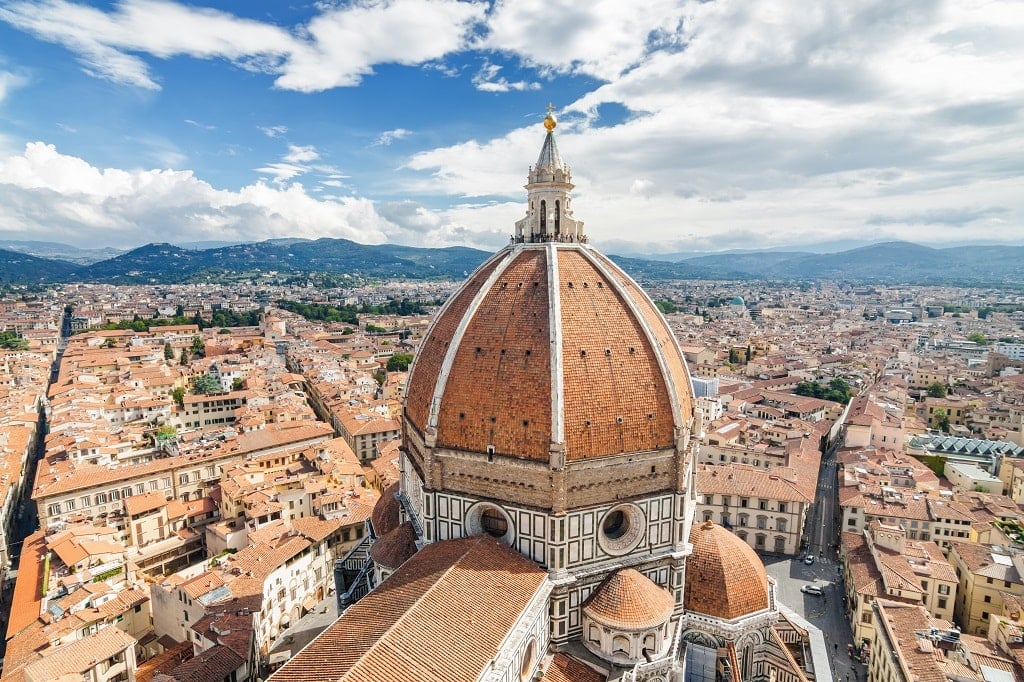
The Florence Cathedral, or, Cathedral of St. Mary of the Flower, to give it its full name, has been the perfect centerpiece of Florence’s elegant skyline since it was complete in 1436. One of the largest church buildings in Italy, its famous dome is the largest brick dome in the world. Its design is based on the principle of inverted tension, which, if you’ve ever tried to break a brick by squeezing it, you will be familiar with. Bricks are naturally good at withstanding compressive forces, and so the Duomo is designed in an upward curved fashion that makes use of this fact, with no buttressing required, much like the Pantheon in Rome.
Inverted tension is great, but having been built out of bricks half a millennium ago, the dome has weathered a storm or two in its time, and cracks have emerged over the years. To complicate matters, The Duomo’s designer, Filippo Brunelleschi deliberately left out some crucial structural details of his design from his models, so that nobody could steal his ideas. Furthermore, the dome’s inner shell is so thick (seven feet thick!) that mapping its internal structural integrity has proved challenging for preservationists. Which is where cosmic rays come in!
Yep, you read that right! Preservationists have turned to subatomic physics to help the restoration project of the Florence Cathedral. In a process that was used to map the Pyramids of Giza, particles called muons are fired through mounted gas chamber detector devices, fixed at points all around the dome, penetrating its thick inner walls. They will eventually image the entire internal structure of the dome, determining if Brunelleschi used any internal iron reinforcements to fortify the brickwork. Only then can preservationists begin to think about how they will go about saving Florence’s beautiful cracking dome.
And you thought that adding that kitchen extension was a hassle!
Want to see more fully-restored renovation wonders?
Find more of them on Tiqets.com or read the blog for more travel inspiration